
Organized by the Justice Academy of Turkey and supported by the Bursa Metropolitan Municipality, the “International Mecelle Symposium (Codification, Implementation, and Its Effects on the Present Day)” was held in Bursa between September 25-27, 2017. The opening speeches of the symposium were delivered by Deputy Prime Minister Hakan Çavuşoğlu, Minister of Justice Abdülhamit Gül, and President of the Court of Cassation İsmail Rüştü Cirit. In their opening remarks, the importance of the Mecelle in the history of law was emphasized, highlighting that all legal professionals should know and internalize it. Furthermore, the hope was expressed that this symposium would serve as a starting point for future academic studies on the Mecelle.
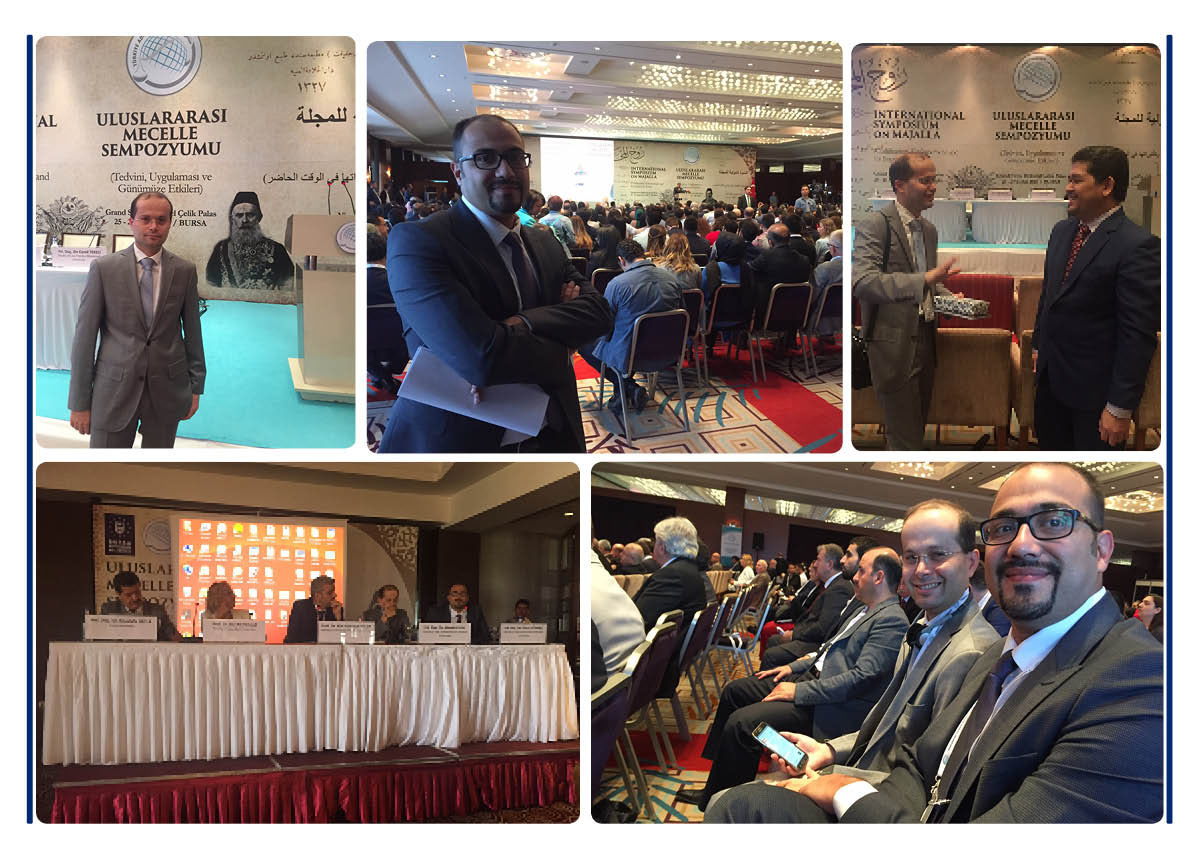
The academic event was attended by Deputy Prime Minister Hakan Çavuşoğlu, Minister of Justice Abdülhamit Gül, President of the Court of Cassation İsmail Rüştü Cirit, as well as the Chairman of the Constitutional Committee of the Grand National Assembly of Turkey Mustafa Şentop, Governor of Bursa İzzettin Küçük, members of parliament, presidents of supreme courts and chief public prosecutors from Jordan and Oman, and numerous scholars. The symposium, which featured 60 speakers from 14 different countries, saw significant participation.
During the second session of the first day, held in the Ali Haydar Efendi Hall, AYBÜ Faculty of Law Vice Dean and faculty member in the Department of Legal History, Asst. Prof. Dr. Ahmet Kılınç, and AYBÜ Faculty of Law Vice Dean and faculty member in the Department of Civil Law, Asst. Prof. Dr. Ünsal Dönmez, presented their papers. In his presentation titled “Statute of Limitations According to the Mecelle: Malfunctions Observed in Practice and Proposed Solutions,” Kılınç detailed the provisions regarding the statute of limitations established in the Mecelle. Shedding light on practical challenges in light of information obtained from archival documents, Kılınç provided critical analysis regarding implementation. In his paper titled “Examination of the Mecelle and Contemporary Codes in Terms of Comparative Legal Technique,” Dönmez conducted a comparative analysis of the Mecelle alongside the civil codes of contemporary states such as France, Germany, Italy, and Austria. Stating that the Mecelle represents the “beginning of a living legal system,” Dönmez demonstrated the significant value of the Mecelle in the history of Turkish private law.