



The analysis titled "Political Violence in Japan and the Assassination of Japan's Former Prime Minister Shinzo Abe: How and Why?" by Asst. Prof. Dr. Md. Nazmul Islam, faculty member at Ankara Yıldırım Beyazıt University (AYBU) Faculty of Political Sciences and Head of the Turkey, Asia, and Indo-Pacific Studies Research Group at the Institute for International Relations and Strategic Research (ULİSA), has been published by ULİSA-Turkey, Asia and Indo-Pacific Studies (TAIPS).
You can access the analysis here.
The analysis written by Ass. Prof. Dr. Md. Nazmul Islam, an Assistant Professor of Political Science in the Department of Political Science and Public Administration and Head of Turkiye, Asia and Indo-Pacific Studies, Institute for International Relations and Strategic Research (ULİSA) at the Ankara Yildirim Beyazit University (AYBU), Ankara, Turkey, has been published by ULİSA-Türkiye, Asia and Indo-Pacific Studies (TAIPS): "Political Violence in Japan and Assassination of Japan’s Former Prime Minister Shinzo Abe: How and Why?"
Political Violence in Japan and the Assassination of Japan's Former Prime Minister Shinzo Abe: How and Why?
Asst. Prof. Dr. Md. Nazmul Islam
Political violence is rare in Japan. Takashi Hara in 1921, Osachi Hamaguchi in 1930, and Tsuyoshi Inukai in 1932 were three instances where a country's leader was assassinated while in office. Iccho Itoh, who served as the mayor of Nagasaki—a city devastated by a nuclear attack in 1945—was assassinated in 2007.[1]
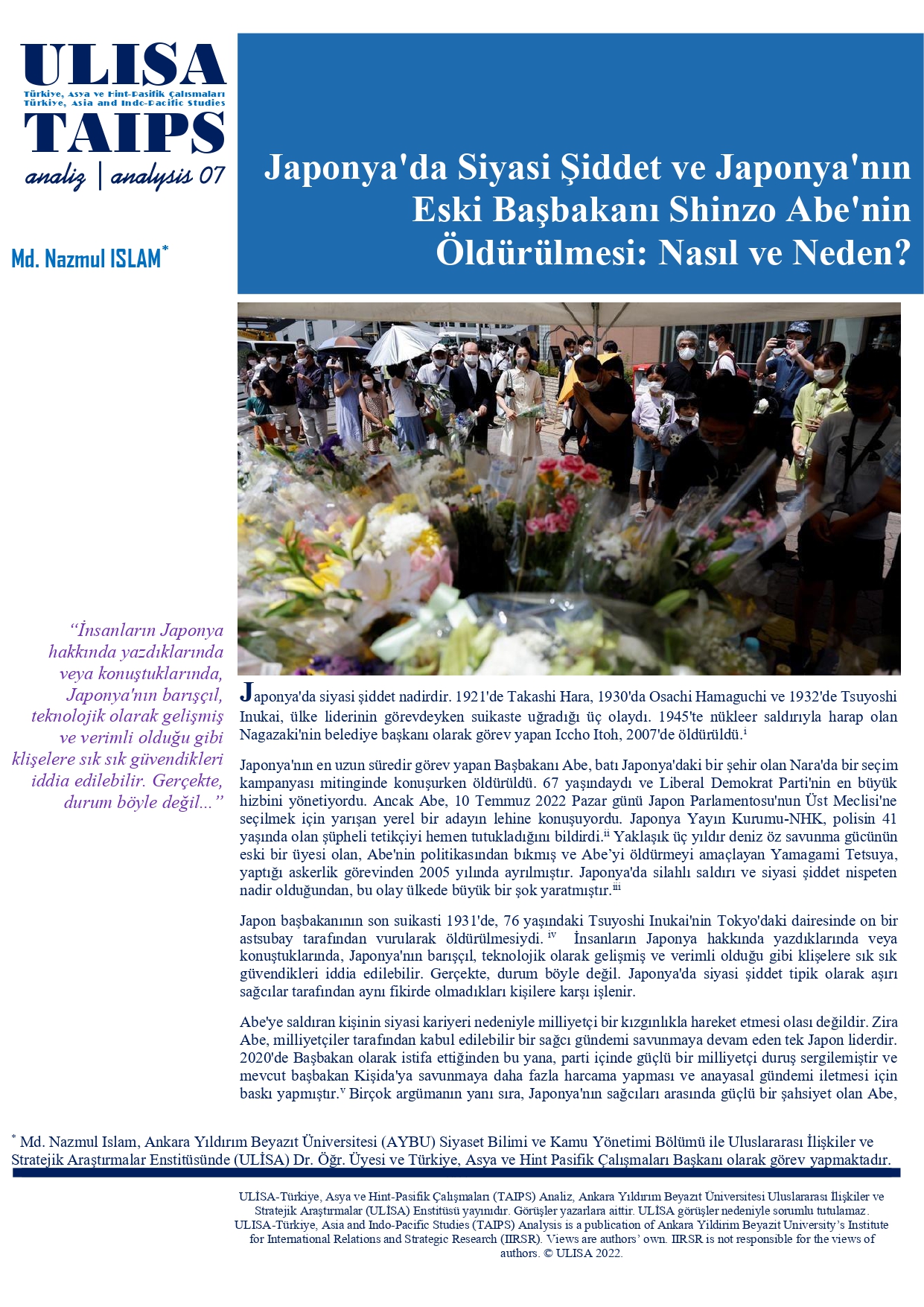
Abe, Japan's longest-serving Prime Minister, was assassinated while speaking at a election campaign rally in Nara, a city in western Japan. He was 67 years old and led the largest faction of the Liberal Democratic Party. However, Abe was speaking in support of a local candidate running for election to the Upper House of the Japanese Parliament on Sunday, July 10, 2022. The Japan Broadcasting Corporation (NHK) reported that police immediately arrested the 41-year-old suspected gunman.[2] Tetsuya Yamagami, a former member of the Maritime Self-Defense Force for about three years who was fed up with Abe's policies and aimed to kill him, left his military service in 2005. Since armed attacks and political violence are relatively rare in Japan, this incident caused great shock in the country.[3]
The last assassination of a Japanese prime minister was in 1931, when 76-year-old Tsuyoshi Inukai was shot and killed by eleven junior officers in his Tokyo apartment.[4] It could be argued that when people write or talk about Japan, they frequently rely on clichés such as Japan being peaceful, technologically advanced, and efficient. In reality, this is not the case. Political violence in Japan is typically perpetrated by right-wing extremists against those with whom they disagree.
It is unlikely that the person who attacked Abe acted out of nationalist anger stemming from his political career. This is because Abe remains the only Japanese leader to continue advocating a right-wing agenda acceptable to nationalists. Since resigning as Prime Minister in 2020, he has maintained a strong nationalist stance within the party, pressuring current Prime Minister Kishida to spend more on defense and advance the constitutional agenda.[5] Amidst various arguments, Abe, a powerful figure among Japan's right wing, was a supporter of imperial Japan's war crimes[6] and supported US hegemony efforts in the Asia-Pacific.[7] Additionally, he was a member of Nippon Kaigi, a fascist group claiming that the war crimes of the Empire of Japan were exaggerated or fabricated, "liberating" Asia from the West, and praising Japanese colonialism.[8] Abe also visited the Yasukuni Shrine multiple times despite opposition from China and Korea. The Yasukuni Shrine houses Japan's war criminals.[9] In October 2018, the South Korean Supreme Court issued the opinion that Japanese companies that used forced labor during World War II should pay $89,000 in compensation to surviving forced laborers. In response, Abe declared a trade war against Korea.[10] Additionally, under Abe, the government took a harsh stance against Koreans in Japan, canceling subsidies for Joseon schools for Zainichi Koreans in Japan. Zainichi Koreans experience systemic discrimination and hardship in Japan.[11] Abe also targeted Okinawa, which suffered twofold under the Japanese rule. In 2019, Abe agreed to relocate a US military base to Okinawa despite more than 70% of its population voting against it in a referendum.[12] Furthermore, there is another argument that Abe's killer targeted him due to his connection with the religious group Touitsu Kyoukai, or the Unification Church.[13][14]
Aside from negative arguments, Abe was Japan's most prominent politician who held the premiership longer than any other leader. In August 2020, when his ulcerative colitis resurfaced, he resigned for a second time due to declining health. When he first took office in 2006 at the age of 52, he was the youngest prime minister in Japan's post-war history.[15] A third-generation politician raised by an elite, conservative family by birth, Abe drew attention with his aggressive, nationalist stances and "Abenomics" economic policies. He sought to strengthen Japan's key partnership with the US by developing a close personal friendship with then-President Trump.[16]
Aside from the above-mentioned issues, Shinzo Abe's views on foreign policy had a profound and lasting impact on US and Asian partnerships, particularly on India. His Indo-Pacific vision was articulated in a speech in India in 2007, where he was a highly popular figure shaping the US Indo-Pacific strategy and the revival of the Quad. The free and open Indo-Pacific concept, which currently forms the basis of US policy, Shinzo Abe's legacy against the rising China will live on long after his death.
[1] Syed Iftikhar and Islam Uddin. (2022). Shinzo Abe murder: Timeline of political assassinations in Japan. Access link: https://www.aa.com.tr/en/asia-pacific/shinzo-abe-murder-timeline-of-political-assassinations-in-japan/2633396
[2] Yvette Tan and Matt Murphy. (2022). Shinzo Abe: Japan ex-leader assassinated while giving speech. Access link: https://www.bbc.com/news/world-asia-62089486
[3] Helen Regan, Emiko Jozuka and Mayumi Maruyama. (2022). Who is Tetsuya Yamagami? What we know about the man suspected of shooting Shinzo Abe. Access link: https://edition.cnn.com/2022/07/09/asia/shinzo-abe-tetsuya-yamagami-explainer-intl-hnk/index.html
[4] Kamal Joshi. (2022). Shinzo Abe Assassinated: Inukai Tsuyoshi, The Last Japan PM Who Was Shot Dead 90 Yrs Ago. Access link: https://www.republicworld.com/world-news/rest-of-the-world-news/shinzo-abe-assassinated-inukai-tsuyoshi-was-last-japan-pm-to-be-shot-dead-90-years-ago-articleshow.html
[5] S. Nathan Park. (2022). Abe’s Nationalism Is His Most Toxic Legacy. Access link: https://foreignpolicy.com/2022/07/14/shinzo-abe-nationalism-japan-korea/
[6] Isaac Chotiner. (2022). How Shinzo Abe Sought to Rewrite Japanese History. Access link: https://www.newyorker.com/news/q-and-a/how-shinzo-abe-sought-to-rewrite-japanese-history
[7] Brad Lendon and Andrew Raine. (2022). 'A free and open Indo-Pacific': With a single phrase, Shinzo Abe changed America's view of Asia and China. Access link: https://edition.cnn.com/2022/07/20/asia/shinzo-abe-legacy-china-japan-indo-pacific-intl-hnk/index.html
[8] Jake Adelstein and Mari Yamamoto. (2022). The Religious Cult Secretly Running Japan. Access link: https://www.thedailybeast.com/the-religious-cult-secretly-running-japan
[9] Shin Ji-hye. (2022). Shinzo Abe visits controversial shrine, sparks fury in Seoul. Access link: http://www.koreaherald.com/view.php?ud=20220421000729
[10] Ben Dooley. (2019). Japan Cites ‘National Security’ in Free Trade Crackdown. Sound Familiar? Access link: https://www.nytimes.com/2019/07/15/business/japan-south-korea-trade-war-semiconductors.html
[11] Steven Borowiec. (2019). The existential crisis facing North Korean schools in Japan. Access link: https://www.aljazeera.com/features/2019/4/22/the-existential-crisis-facing-north-korean-schools-in-japan
[12] Justin McCurry. (2019). Okinawa rejects new US military base but Abe vows to push on. Access link: https://www.theguardian.com/world/2019/feb/24/okinawa-referendum-rejects-new-us-military-base-but-abe-likely-to-press-on
[13] Mariko Oi. (2022). Shinzo Abe killing: Why a religious group has been put in the spotlight. Access link: https://www.bbc.com/news/world-asia-62173865
[14] Ben Dooley and Hisako Ueno. (2022). In Japan, Abe Suspect’s Grudge Against Unification Church Is a Familiar One. Access link: https://www.nytimes.com/2022/07/23/world/asia/japan-unification-church-lawsuits.html?smid=nytcore-ios-share
[15] BBC. (2020). Shinzo Abe: Japan's PM resigns for health reasons. Access link: https://www.bbc.com/news/world-asia-53943758
[16] Jack Detsch and Amy Mackinnon. (2022). Abe’s Legacy Will Outlive Him. Access link: https://foreignpolicy.com/2022/07/08/shinzo-abe-assassination-japan-indo-pacific-security/