SBF MEETINGS 1 (PANEL ON “ALIJA IZETBEGOVIC” ON THE 14TH ANNIVERSARY OF HIS PASSING) HELD
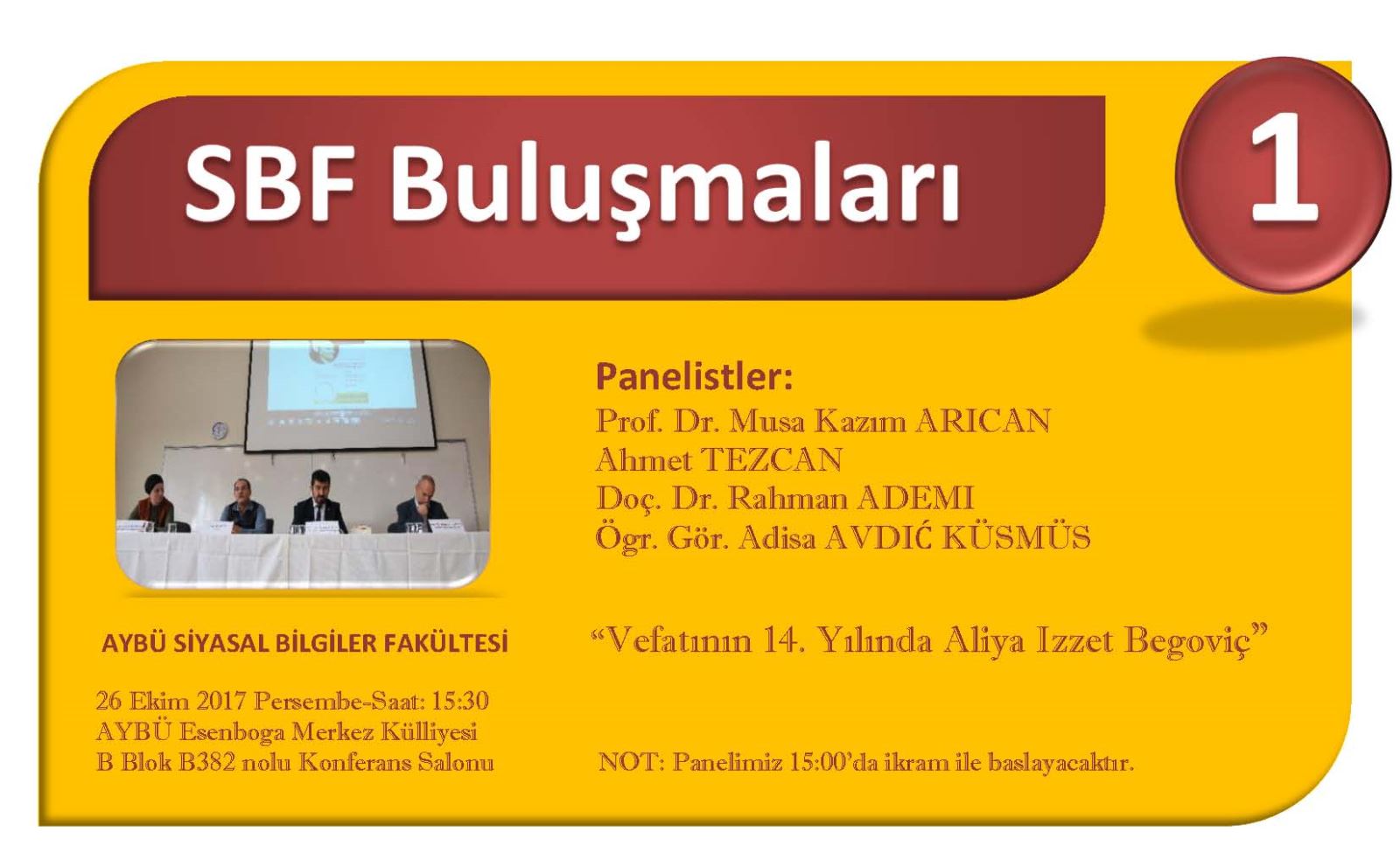 The commemorative panel for Alija Izetbegović, organized by the Faculty of Political Sciences and the Department of International Relations of our university, was held under the moderation of our University Vice-Rector Prof. Dr. Musa Kazım Arıcan, with the participation of Assoc. Prof. Dr. Rahman Ademi, Lecturer Adisa Avdić Küsüş, and author Ahmet Tezcan.
In his opening speech, Deputy Head of the International Relations Department, Assoc. Prof. Dr. Giray Sadık, emphasized the significance of Alija Izetbegović in terms of Turkish political history. Subsequently, the trailer for the series "Aliya," which features screenwriter and panelist Ahmet Tezcan and is scheduled to air on TRT in January, was screened.
The panel, moderated by Prof. Dr. Musa Kazım Arıcan, highlighted Izetbegović’s efforts for Bosnia and his intellectual structure, with participants noting that "Aliya is a shared name for everyone." The first speaker, author Ahmet Tezcan, shared that he was deeply influenced by his first visit to Bosnia in 2004 while serving as the press advisor to then-Prime Minister Recep Tayyip Erdoğan. Emphasizing that Bosniaks are structured differently from Turks—being more Western-oriented and composed—the author shared anecdotes about the daily life and social aspects of Bosnia and Herzegovina. In the context of Alija, he highlighted that Izetbegović often used the adjective "Muslim," a quality he largely inherited from his mother. Evaluating Izetbegović’s perspective in his book *Escape to Freedom*, the author noted that for Alija, "consent" (rida) was the fundamental principle of the universe's origin. Looking at the broader picture, he expressed that the core of everything lies in "confession with the tongue and affirmation with the heart." Highlighting Izetbegović’s humanity, the author stated that he was first a good human being, which in turn made him a good Muslim.
The second speaker, Adisa Avdić Küsüş, emphasized that unfortunately, Alija Izetbegović has not received the full recognition he deserves in Bosnia, while in Europe, he has been unfairly portrayed alongside other nationalist leaders who instigated the war. Stating that Izetbegović’s ideas are important for everyone, Avdić Küsüş mentioned two of his key predictions: "1) Communism will collapse... 2) Islam will rise." She stated that while the first prediction came true, the second has yet to be realized due to a lack of knowledge and unity. Furthermore, the lecturer underscored the importance Izetbegović placed on women's education, noting that he advocated for women to have equal rights in the social structure as men.
Finally, Assoc. Prof. Dr. Rahman Ademi spoke about the social structure in Sarajevo, where divisions between people are not clearly defined and everyone is equal as long as they meet at the mosque. Focusing on Izetbegović’s youth, Rahman Ademi highlighted the internal conflicts Alija experienced between his heart and his intellect, noting that he felt happiest when these two were in harmony. He also mentioned that Alija was a leader extremely open to criticism and did not impose censorship on the media even during the war. Lastly, referring to a question posed by a German journalist during an interview asking why he did not order revenge despite such oppression, Ademi noted that Alija’s response—"The book I believe in does not allow it"—perfectly illustrated the importance he placed on his Muslim identity and his way of life.